


Community Advocates’ Aging with Stability initiative aims to meet a growing need in our community—but it’s deeply personal, too.
Like many human services providers, we’ve seen a troubling increase in the number of older adults experiencing homelessness or housing insecurity in Milwaukee County. Instead of enjoying their senior years with peace and dignity, more elders are living in encampments or cars, experiencing street homelessness, or struggling to keep up with housing costs amid an ongoing cost-of-living crisis.
According to the January 2026 Point-in-Time Count, 37% of Milwaukee County’s childless population staying in shelters or experiencing homelessness is age 55 or older.
Through our housing programs, Community Advocates welcomes seniors seeking stability, health, and wellness. For example, within our supportive housing programs, 52% are age 55 and older and have an income. But we began asking important questions: Are our programs—and others throughout Milwaukee County—equipped to meet the expanding housing, medical, and behavioral health needs of older adults experiencing housing instability?
Those questions inspired us to learn more about elder housing insecurity in Milwaukee County. We convened focus groups, conducted qualitative and quantitative research, and hosted community discussions focused on the needs, capacities, and future of health and housing services for older adults. Our goal is to ensure we are prepared for the demographic and resource shifts already underway.
Hearing from Our Elders
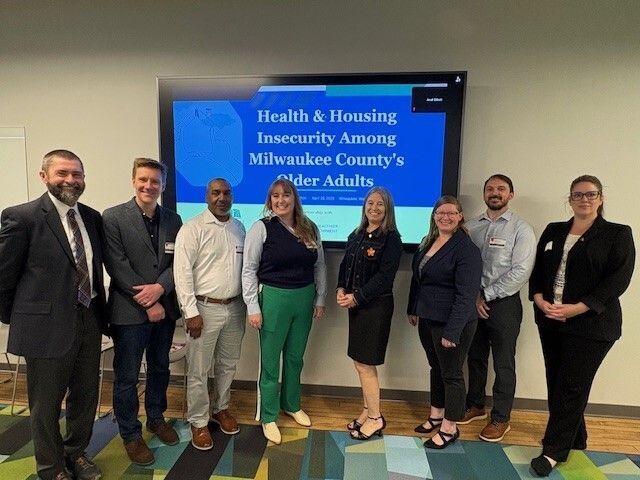
On April 28, Community Advocates hosted a presentation and panel discussion centered on the experiences of older adults facing housing insecurity and what service providers—and the broader community—can do to help.
The event began with a presentation by researcher Katherine Kishline on Community Advocates’ survey of 118 older adults experiencing housing insecurity, as well as interviews with 17 community stakeholders. The research was conducted in partnership with David Nelson, Ph.D., of the Medical College of Wisconsin and supported by a 2025 Advancing a Healthier Wisconsin seed grant.
Overall, elders reported that the system itself often becomes a barrier to accessing services. Challenges included not knowing where to seek help, long wait times, unreliable transportation, and lack of phone access. At the same time, Kishline and Dr. Nelson found strong enthusiasm among stakeholders to collaborate on solutions for older adults facing housing instability.
“The ideas are there,” Kishline said. “The collaborative spirit is there. Now we have the opportunity to make real change and have the discussion and really start to dig deeper.”
Dr. Nelson remarked on the disconnect between elders and service providers that the research identified.
“Everybody that we talked to said this is a growing issue, elder homelessness,” Dr. Nelson said. “We know that we’re the graying of America, we’ve got four generations in the workforce. But many people that we intersected with didn’t know where to go for help, even though there’s a whole lot of help out there.”
Health Impacts of Homelessness
To learn more about the resources and services available in the community, Dr. Nelson moderated a panel discussion featuring:
Bill Calawerts, MD MPH, MCW-North Side Family Medicine Residency, Outreach Community Health Center
Erin Cronn, BSN, RN, Director of Nursing, City of Milwaukee Health Department
Emily Kenney, LCSW, Director of Strategic Initiatives and Transformation, Milwaukee County Department of Health and Human Services
Matt Raymond, Supportive Housing Program Director, Community Advocates
Research indicates that elders experiencing homelessness typically have the health issues of someone 20 years older who enjoyed housing stability. Dr. Calawerts said that even one day of homelessness can trigger health issues, likely due to the activation of the “stress axis,” the hypothalamic-pituitary-adrenal or HPA axis. This creates an extended fight-or-flight reaction that negatively impacts mental and physical health.
Dr. Calawerts said the current generation of medical students is becoming increasingly aware of the “political determinants of health”—the policies and systemic decisions that create inequities and ultimately shape health outcomes. One of the most significant determinants, he said, is housing. And without housing, an individual’s health treatments, preventive care, and medications typically fall by the wayside.
“Housing is a medical diagnosis in itself,” Calawerts said.
Erin Cronn emphasized the harmful effects of social isolation and the lack of community support for older adults experiencing homelessness.
“In our system, even getting treatment is an isolating experience,” Cronn said. “In some of the encampments we’ve visited, there’s real community there. People are supporting each other. Leaving that community often means becoming isolated again within a system where you have very little control over what happens to you.”
Navigating “The System”
Emily Kenney explained that many people assume there is a single “housing system” they can access for services and support. In reality, she said, that system does not truly exist.
“We do not have services for people who are losing their housing because of lost income,” Kenney said. “We don’t have a housing solution for someone who can no longer stay in their apartment because their health has declined. There isn’t one clear system people can access to solve those problems.”
Instead, Kenney noted, many people only gain access to services after they have already experienced homelessness—and rebuilding stability afterward can take years.
“Why don’t we start creating a system that works for people in the way they’re actually asking for it?” she said. “People are calling and saying, ‘I need an apartment with lower rent. I need a place where I can stay healthy. I need support from a case manager while I’m still housed.’ Right now, many are living in unsafe or unhealthy conditions with nowhere to turn. As a community, we need to work collaboratively to provide that help before people lose their housing.”
Community Advocates’ Matt Raymond said he was heartened by the collective enthusiasm for providing elders with appropriate housing and health care. What helps, he said, is existing frameworks. “We’ve kind of been here before,” he said.
Previous initiatives have focused on and reduced homelessness among families, veterans, domestic violence survivors, and people with severe and persistent mental illness.
“Now is the opportunity to look at what is the largest growing population cohort in our homeless system, these aged individuals over 50, and start to target in on it,” Raymond said. “I think we’ve got tools to be able to do that.”